
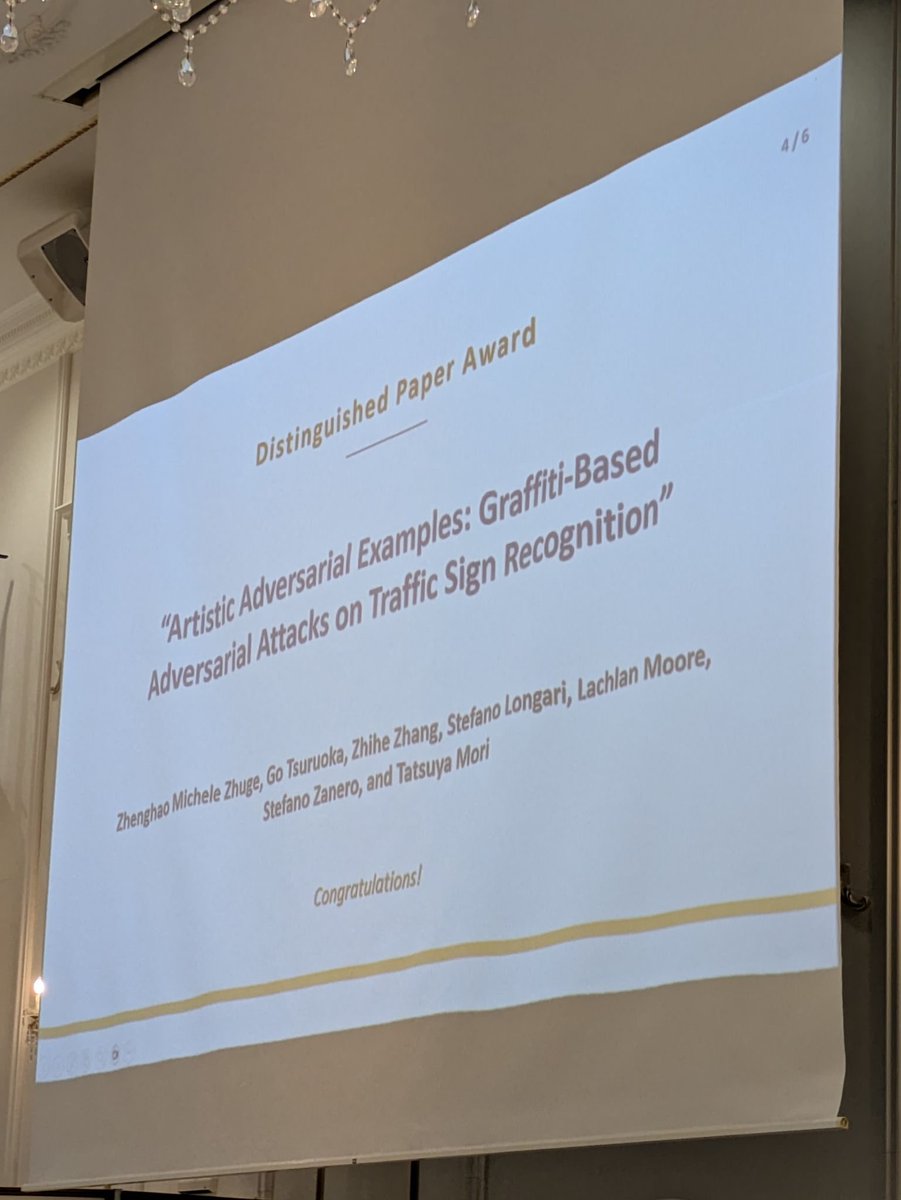
We are delighted to announce that our paper “Artistic Adversarial Examples: Graffiti-Based Adversarial Attacks on Traffic Sign Recognition” received the Distinguished Paper Award at the 28th International Conference on Information and Communications Security (ICICS 2026), held in Fukui, Japan, on October 27–30, 2026. This work is a fruit of our international collaboration with Politecnico di Milano. Congratulations to Zhuge-kun, who led the work and presented it in Fukui, and kudos to the entire team!
In this work, we propose artistic adversarial examples — adversarial patches crafted to look like ordinary street graffiti so that they blend naturally into urban scenes. Combining a graffiti-trained generative model with a two-stage optimization that couples white-box latent optimization and black-box placement refinement, our attack degrades traffic sign detection while keeping the perturbations visually plausible. Extensive experiments across digital, simulated, and physical settings show that the generated graffiti substantially disrupts traffic sign recognition, achieving up to a 72.8% attack success rate with an average confidence drop of 65.8%.
Zhenghao Michele Zhuge, Go Tsuruoka, Zhihe Zhang, Stefano Longari, Lachlan Moore, Stefano Zanero, and Tatsuya Mori, "Artistic Adversarial Examples: Graffiti-Based Adversarial Attacks on Traffic Sign Recognition." In Proc. of the 28th International Conference on Information and Communications Security (ICICS 2026), Fukui, Japan, Oct 2026, pp. 198–219. Distinguished Paper Award [DOI][Springer]