
A paper got accepted!

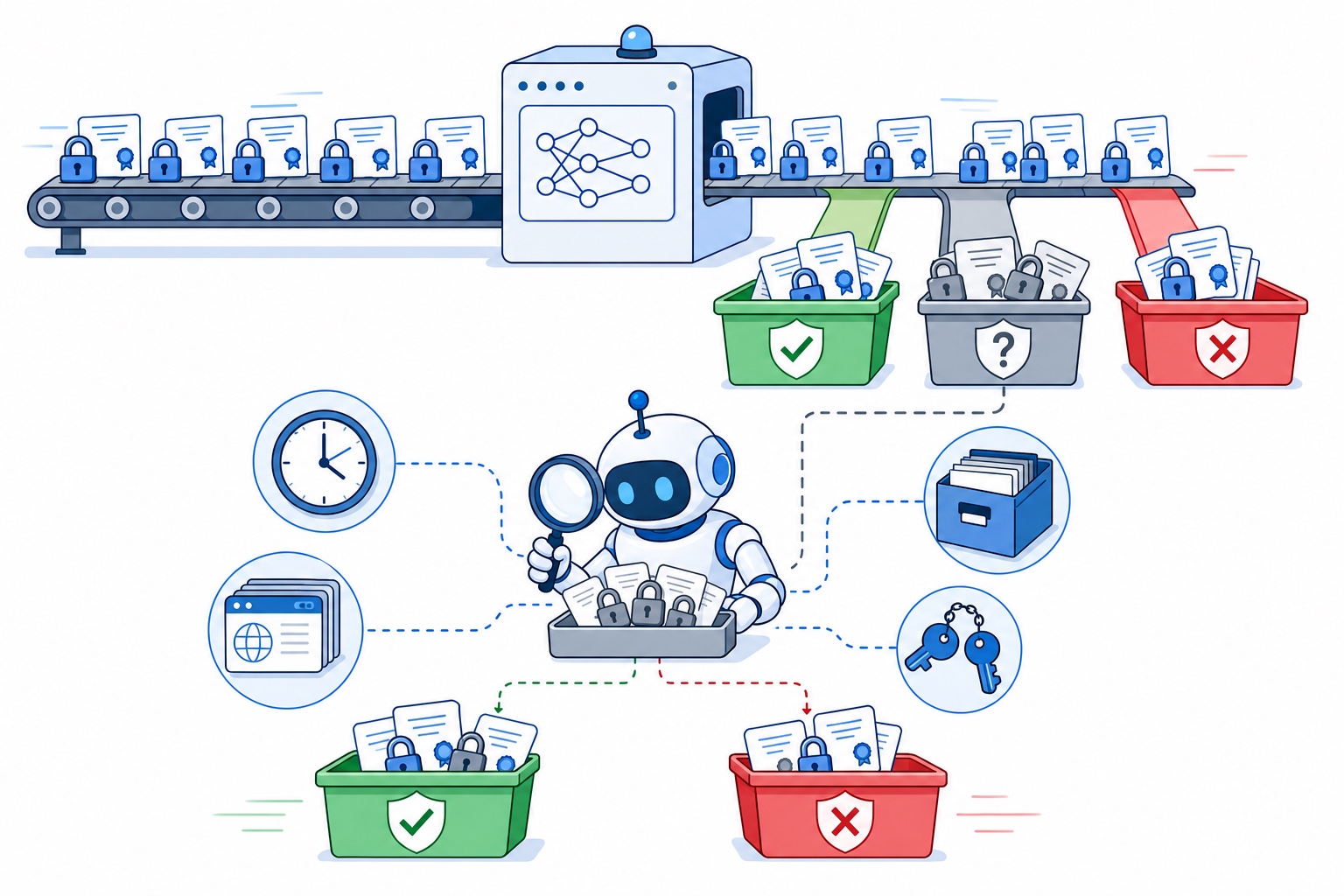
We are thrilled to announce that our journal paper entitled “Resolving the Classifier’s Gray Zone: A Tool-Augmented LLM Agent for Phishing Detection at Certificate-Issuance Time” has been accepted for publication in IEICE Transactions on Information and Systems, Special Section on Information and Communication System Security. Congratulations Asomura-san, and kudos to Iijima-san!

In this work, we tackle the gray zone of phishing detection: the domains that even a state-of-the-art supervised classifier cannot confidently assign to either class, where misses and false alarms concentrate. We propose a two-layer system in which high-confidence domains are decided automatically by machine learning and only the gray zone is handed to GrayLens, a tool-augmented LLM agent that reproduces an analyst’s investigation by combining Certificate Transparency issuance history, Wayback Machine archives, SubjectPublicKeyInfo (SPKI) sharing analysis, and brand impersonation detection, without fetching the target’s live page. On a gray-zone evaluation set of 24,633 domains, where XGBoost drops to F1 = 0.7334, the agent raises F1 to 0.9675 and cuts the miss rate from 36.4% to 2.5%. We also find that phishing domains share an SPKI hash with other domains 65.6% of the time, about 15 times the 4.4% rate of legitimate domains.

Ichiro Asomura, Ryo Iijima, and Tatsuya Mori. "Resolving the Classifier’s Gray Zone: A Tool-Augmented LLM Agent for Phishing Detection at Certificate-Issuance Time." IEICE Transactions on Information and Systems, Special Section on Information and Communication System Security, to appear (Jun 2027).

A paper got accepted!

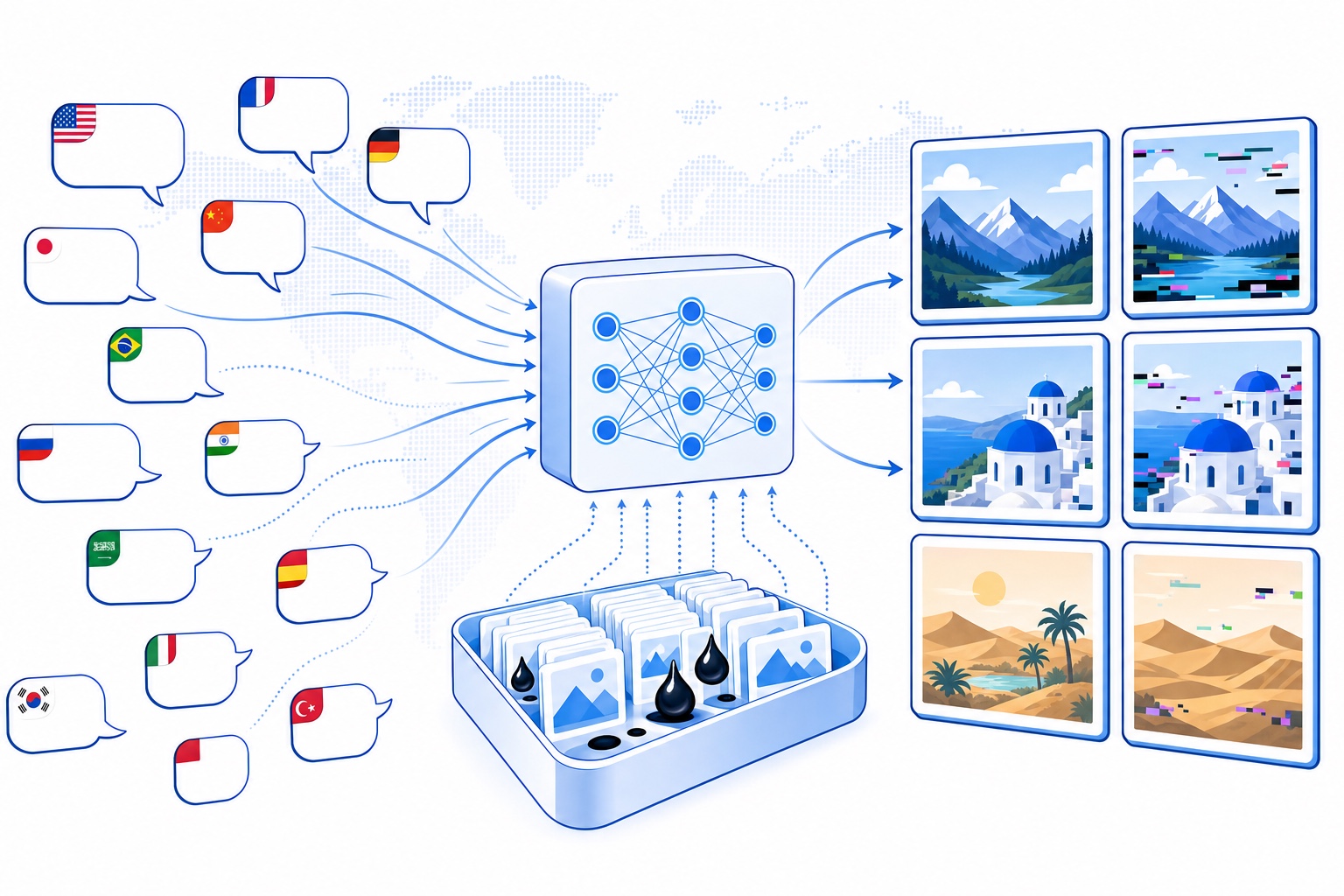
We are thrilled to announce that our journal paper entitled “Not All Languages Are Equally Safe: Evaluating Cross-Lingual Data Poisoning Attacks Against Text-to-Image Models” has been accepted for publication in IEICE Transactions on Information and Systems, Special Section on Information and Communication System Security. This paper is an extended version of our ICPR 2026 paper. Congratulations Kakebayashi-kun!

In this work, we systematically evaluate the vulnerability of text-to-image (T2I) models to data poisoning attacks across 10 languages. We show that poisoned data constructed in English transfers to non-English prompts, and that several languages, such as Indonesian, Japanese, and Turkish, are notably more vulnerable than English, on both Stable Diffusion v2 and SDXL. Our analysis indicates that syntactic and genetic distance from English, as well as weaker cross-lingual alignment of the text encoder, are associated with higher attack success rates. Finally, we show that fine-tuning the text encoder with non-English data to improve cross-lingual alignment can reduce attack success rates.

Ryohei Kakebayashi and Tatsuya Mori. "Not All Languages Are Equally Safe: Evaluating Cross-Lingual Data Poisoning Attacks Against Text-to-Image Models." IEICE Transactions on Information and Systems, Special Section on Information and Communication System Security, to appear (Jun 2027).

A paper got accepted!

We are thrilled to announce that our journal paper entitled “DAP: Physically Realizable and Controllable Dynamic Adversarial Patch Attack Against Feature-based Visual Localization” has been accepted for publication in IEICE Transactions on Information and Systems, Special Section on Information and Communication System Security. Congratulations Zhang-kun and Peng-kun!

In this work, we present DAP (Dynamic Adversarial Patch), a physically realizable attack against feature-based visual localization, which underpins navigation in autonomous vehicles, mobile robots, and drones. By displaying dynamically changing content, DAP creates coherent, trackable feature correspondences that steer pose estimation in an attacker-chosen direction, while the feature-inducing structure is hidden inside ordinary advertisement content by an environment-adaptive generation pipeline. Evaluations in the CARLA simulator and in the real world across representative feature-based pipelines show that DAP induces systematic, directional drift with a stable inverse relationship between patch motion and trajectory deviation, and we examine lightweight pipeline-level mitigations that substantially reduce the effect.

Zhihe Zhang, Shuo Peng, and Tatsuya Mori. "DAP: Physically Realizable and Controllable Dynamic Adversarial Patch Attack Against Feature-based Visual Localization." IEICE Transactions on Information and Systems, Special Section on Information and Communication System Security, to appear (Jun 2027).